

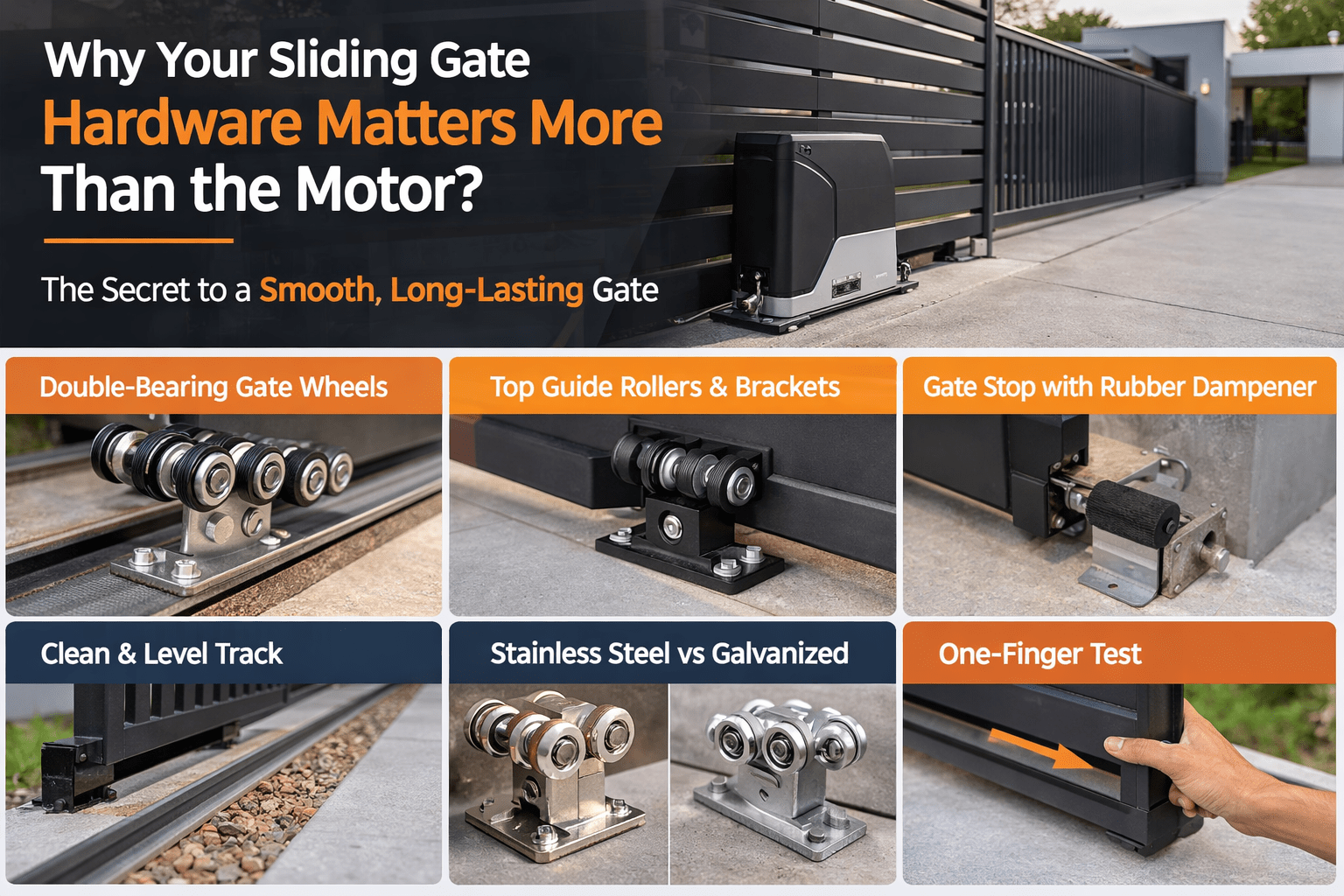
Why Your Sliding Gate Hardware Matters More Than the Motor?
When most people plan a sliding gate installation, they spend hours choosing the
perfect timber finish or the latest automatic gate motor with smartphone control.
While those features improve curb appeal and convenience, they aren’t what actually
makes a gate operate smoothly. The real foundation of a reliable system lies in its
sliding gate hardware.
A sliding gate is only as good as the wheels, tracks, rollers, and guide brackets it sits on.
While the motor and finish get all the attention, the hardware does the mechanical
“heavy lifting” every single day. If your automated gate feels heavy, makes grinding
noises, or struggles when cycling, the issue is usually low-quality or poorly specified
hardware. Choosing the right components is about more than just movement—it’s
about protecting your investment and ensuring long-term property security.
The “One-Finger Test”: A Simple Performance Check
A professionally installed sliding gate system should pass what experts call the “one
finger test.” When the motor is switched to manual mode, you should be able to move
the entire gate along its track with just one finger.
If you need to use your body weight to push the gate, your gate opener is working far
harder than it was designed to. This excessive friction and strain lead to:
- Motor Fatigue: Shortening the lifespan of the drive unit.
- Worn Internal Gears: Leading to costly mechanical failures.
- Circuit Board Overheating: Caused by the motor drawing too much current tovercome friction.
By installing high-quality double-bearing gate wheels, you distribute the gate’s weight
evenly across the axle. This dramatically reduces rolling resistance, allowing even heavy
steel gates to glide effortlessly, significantly extending your motor’s life.
Why Guide Rollers and Brackets Matter for Stability
While the wheels carry the vertical weight, the top guide rollers and brackets provide
the necessary lateral stability. For large, wide, or high-wind-area gates, a standard two
roller guide bracket is rarely sufficient.
Upgrading to a four-roller nylon guide bracket creates a stabilizing “cradle.” This is
essential for:
1. Reducing Vibration: Eliminating the annoying rattling sound during operation.
2. Wind Resistance: Preventing the gate from bowing or jumping out of the track
during storms.
3. Reducing Lateral Stress: Ensuring the gate stays perfectly vertical so the
bottom wheels don’t wear unevenly.
Using high-grade nylon rollers with internal bearings ensures the gate stays quiet and
doesn’t scratch the powder-coated finish of your gate frame.
Environmental Factors: Choosing the Right Materials
One common mistake is using the same hardware for every environment. To ensure
your hardware lasts, consider your location:
• Inland Areas: Galvanized steel hardware offers excellent rust protection and
durability for standard residential use.
• Coastal Regions: If you are near the ocean, salt air will corrode standard steel in
months. In these areas, 316-grade stainless steel wheels and tracks are a
mechanical necessity to prevent the bearings from seizing.
The Most Overlooked Hardware: Gate Stops and Rubber Dampeners
The gate stop is often the most ignored component, yet it performs a vital safety
function. A heavy sliding gate carries massive kinetic energy. Without proper
dampening, the gate slams into the end-post with a harsh metal-on-metal impact.
Installing rubber bungs (dampeners) on your gate stops is a small investment that
yields big results. They absorb the shock of the gate’s momentum, protecting the
motor’s sensitive limit switches and preventing the gate from “bouncing” back, which
can often trigger the motor’s safety auto-reverse feature.
Pro-Active Maintenance: Keeping the Glide
To keep your hardware in peak condition, we recommend a simple “seasonal check”:
• Keep the Track Clear: Sweep the sliding gate track regularly. Small stones or
debris act like speed bumps that damage wheel bearings over time.
• Lubrication: Avoid thick greases that attract dirt and sand. Instead, use a dry
silicone spray on the rollers and wheels to maintain a silent glide.
• Check Alignments: Ground shifts over time. Ensure your track is still level so the
motor isn’t fighting an “uphill” battle in one direction.
Conclusion: Invest in Quality Once
In the world of automated gates, the hardware may be invisible, but it is the silent
foundation that keeps everything running. By prioritizing high-quality wheels, tracks, and
stabilizing rollers, you aren’t just buying parts—you are buying peace of mind.
High-quality hardware ensures effortless movement, a longer motor lifespan, and
significantly lower maintenance costs over the life of your gate. Don’t let a premium
motor be undermined by budget hardware.