

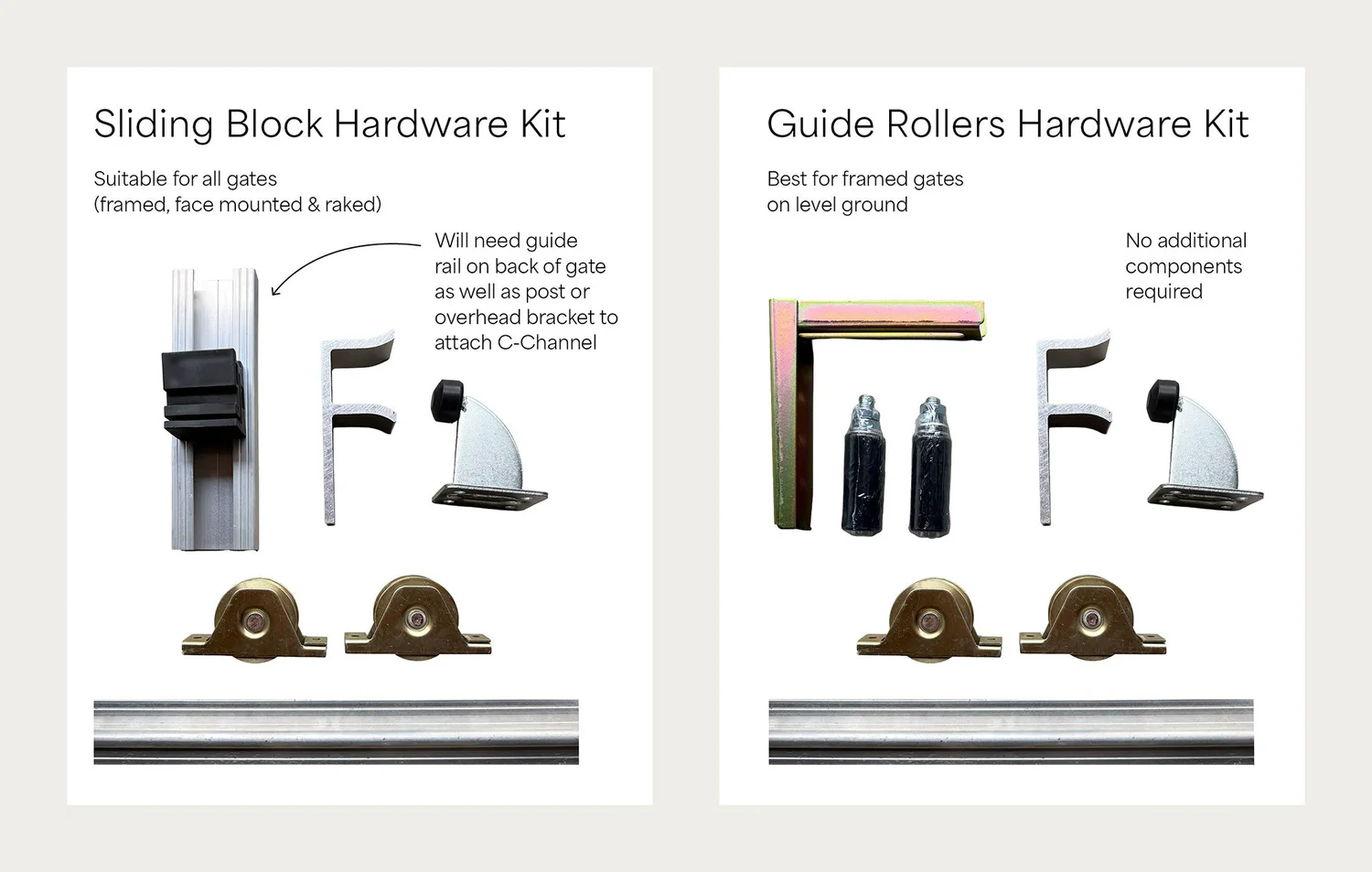
Distributed by: Mytoolsshop
Website: www.mytoolsshop.co.uk
Whatsapp: 07535571742
1. THE “TOP-DOWN” ALIGNMENT STRATEGY
To ensure the gate moves smoothly and stands perfectly vertical, the track position must be
dictated by the top guide bracket.
1. Mount the Guide Bracket: Secure the bracket to your pillar or wall using M10 or M12
Shield Anchors.
2. Establish the Plumb Line: Drop a plumb line (or use a spirit level) from the center of
the nylon rollers down to the driveway. Mark this point.
3. The String Line: Stretch a string line from this mark across the entire length of the
gate’s travel path. This line represents the exact center-line of your floor track.
4. Clearance Check: Ensure a 20mm–30mm gap between the gate frame and the pillar to
allow for movement without scraping.
2. HARDWARE & FIXING SPECIFICATIONS
Using the correct fixings is critical to prevent hardware from vibrating loose or shearing under
load.
| Component | Recommended Fixing | Min. Size | Requirement |
|---|---|---|---|
| Top Guide Bracket | Shield Anchors / Chemical Anchors | M10 / M12 | Must resist lateral wind loads. |
| Floor Track | Countersunk Concrete Screws | 6mm x 50mm | Heads must be flush with track. |
| Gate Wheels | High-Tensile Bolts + Nyloc Nuts | M10 | Prevents loosening from vibration. |
| End Catcher | Sleeve Anchors (Brick) / Tek Screws (Steel) | M8 | Stabilizes gate in the closed position. |
| Safety Post | In-Ground Concrete Footing | 600mm Deep | Critical fail-safe to prevent tip-over. |
3. SAFETY INFRASTRUCTURE (MANDATORY)
The Safety “Fail-Safe” Post:
Hardware can wear out or fail due to extreme weather or fatigue. A falling sliding gate is a
lethal hazard.
● You must install a secondary steel “Safety Post” parallel to the guide pillar.
● This post creates a physical “pocket.” If the top bracket fails or a roller shears off, the
gate will lean against this post rather than falling onto a person or vehicle.
4. LEGAL DISCLAIMER & SAFETY WARNING
READ CAREFULLY BEFORE PROCEEDING
Professional Installation Recommended: This guide is provided by
Mytoolsshop for informational purposes only. Sliding gates are heavy, high-tension
systems. We strongly recommend that all hardware be installed by a qualified
professional.
Assumption of Risk: By performing this installation, the user/installer assumes all
risks associated with the assembly, mounting, and operation of the gate hardware.
Mytoolsshop shall not be held liable for any direct, indirect, incidental, or
consequential damages, including but not limited to:
● Property damage resulting from improper alignment or fixing.
● Personal injury or death caused by gate tip-over or component failure.
● Failure of hardware due to inadequate structural support (e.g., weak pillars
or crumbling concrete).
Compliance: It is the installer’s responsibility to ensure the gate meets all local
building codes and safety regulations.
Warranty Limitation: Warranty is strictly limited to manufacturing defects of the
hardware itself. Warranty is voided if hardware is installed incorrectly, modified,
overloaded beyond its rated capacity, or maintained poorly.
5. MAINTENANCE & CARE
● Clear the Track: Sweep the track regularly. A single pebble can derail a gate.
● Do Not Grease the Track: Grease attracts abrasive grit that grinds down both the
wheels and the track.
● 6-Month Inspection: Check all bolts for tightness and inspect nylon rollers for
sun-damage or cracking. Replace components immediately if wear is detected.